EXECUTIVE DIRECTOR’s REPORT: 68th SESSION OF THE COMISSION ON THE STATUS OF WOMEN 2024
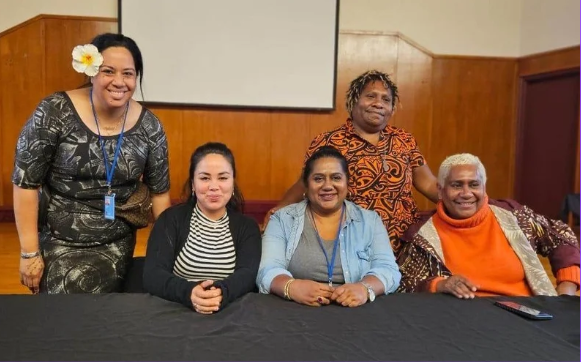
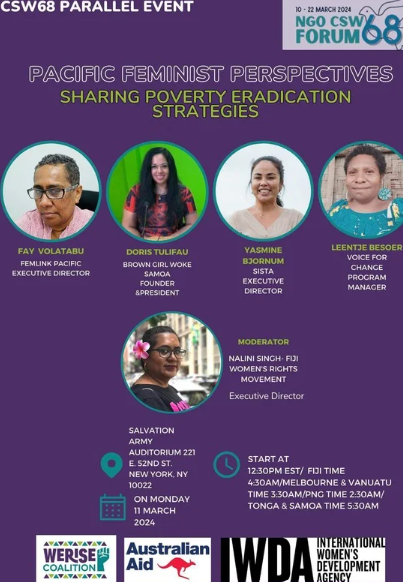
From left - Founder and President of BROWN GIRL WOKE, Doris Tulifau, Executive Director of SISTA, Yasmine Bjornum, Fiji Women’s Rights Movement Executive Director, Nalini Singh, Voice for Change Jiwaka Program Manager, Leentje Besoer and Executive Director of femLINKpacific, Fay Volatabu
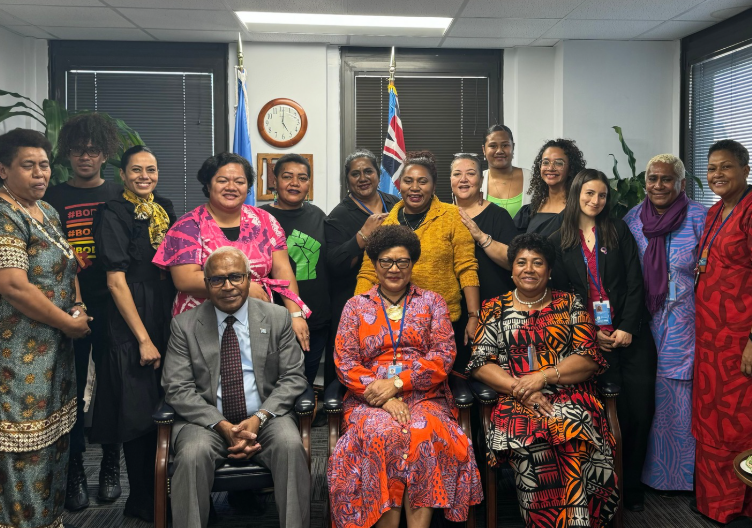
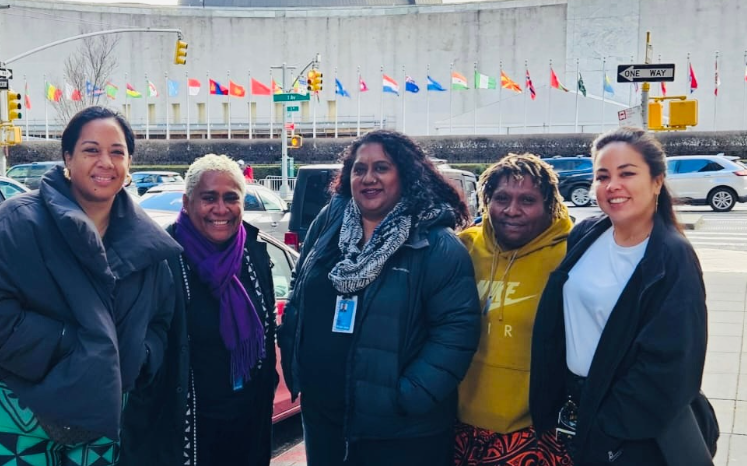
This year I was fortunate to be part of the CSW with Executive Directors of four other organizations that make up the WE RISE Coalition. The WE RISE Coalition is a coalition of feminist organizations in the Pacific and this include the International Women’s Development Agency (Australia), Fiji Women’s Rights Movement(Fiji), Brown Girl Woke (Samoa), SISTA(Vanuatu), Voice for Change-Jiwaka( PNG). The WE RISE COALITION members were able to attend the CSW as IWDA has ECOSOC status. The meeting was for two weeks from the 11th- 22nd of March and this is when governments all over the world report on the progress of Beijing and the problems they encounter whilst trying to ensure Beijing Declaration is followed.
As government delegations give their reports, CSO leaders listen in to see how the reports reflect the reality in each of their countries. In addition to the reporting, there are also side events organized by the UN and the Civil Society Organizations. This year more then 300 side events were organized all over the UN building Complex ,and nearby buildings and this included panel discussions, workshop type presentations or discussions.
The women delegates and CSO leaders had a wide variety of sessions to choose from and some of the topics covered were Water Health and Sanitation, Climate Change, Disaster Preparedness, Cyber Security, Media, Business , Digital Innovations and how all these relate to the theme. The theme for this year was “Accelerating the achievement of gender equality and the empowerment of all women and girls by addressing poverty and strengthening institutions and financing with a gender perspective”.
The WE RISE COALITION (WRC) also had a session and the panel discussion was titled : Pacific feminist Perspectives Sharing Poverty Eradication Strategies. This was attended by organizations in the Pacific and even some donor agencies representatives. The WRC members also participated in other panels and discussions and information gathered would be really beneficial in the various organizations.
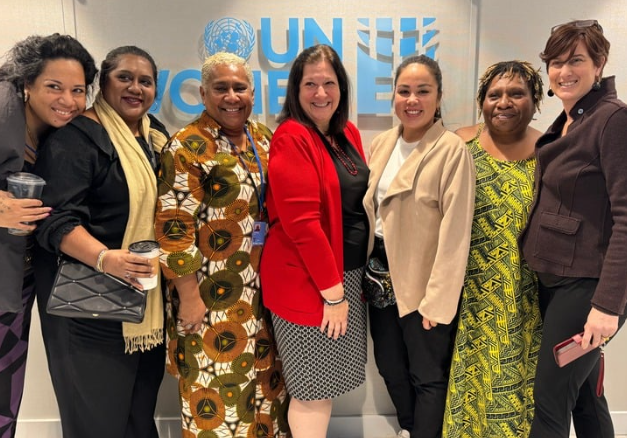
The WRC also had time to visit their own embassies and also the UNWomen office in New York. The trip though very short was an enormous opportunity to Build new networks, make new friends whilst committing to the global agenda of monitoring the progress of Beijing Declaration and Platform of Action.
Next year the CSW will be looking at 40 years since Beijing and analysing progress and problems over the last 40 years.
I was fortunate to be part of this year’s CSW and it is an event that every women CSO leader should embark to be part of as it helps us in reaffirming the work we do, and what more we need to do, to ensure that Women’s issues, Women’s Concerns, Women’s Rights and Women’s Lives matter and that they must be at the forefront of every nations development and fiscal plans. I thank the WRC for this opportunity to be have our concerns raised at the global level and to have the good fortune to bring back learnings from CSW to be shared with our rural and local networks and communities in the form of the Agreed Conclusion of the particular CSW. It would be beneficial to have a read of Agreed Conclusion for CSW 68 to know what transpired in this year’s CSW.
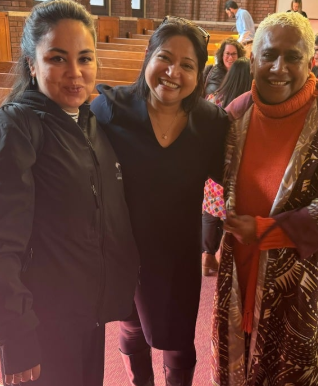
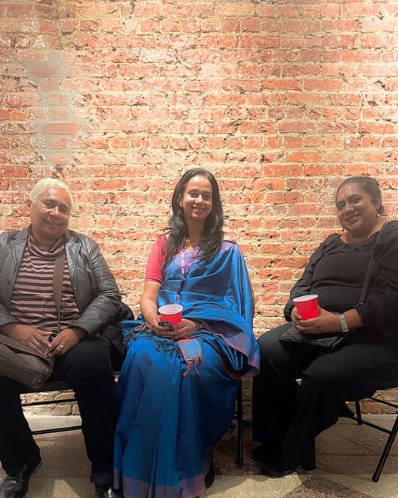
From the left - SISTA Executive Director Yasmine Bjornun, IWDA CEO Nayomi Kannangara, and femLINKPacific Executive Director, Fay Volatabu
WHAT IS THE CSW?
The Commission on the Status of Women (CSW) is the principal global intergovernmental body exclusively dedicated to the promotion of gender equality and the empowerment of women. The CSW is instrumental in promoting women’s rights, documenting the reality of women’s lives throughout the world, and shaping global standards on gender equality and the empowerment of women
It was established by UN Economic and Social Council resolution 11(II) of 21 June 1946 and is a functional commission of the Economic and Social Council (ECOSOC),
In 1996, ECOSOC in resolution 1996/6 expanded the Commission’s mandate and decided that it should take a leading role in monitoring and reviewing progress and problems in the implementation of the Beijing Declaration and Platform for Action, and in mainstreaming a gender perspective in UN activities.
The CSW membership consists of 45 States elected by ECOSOC on the basis of equitable geographical distribution as follows:
13 members from Africa,
11 from Asia,
9 from Latin America and Caribbean,
8 from Western Europe and other States,
4 from Eastern Europe.
New members are elected for a four-year term when the term of the incumbent expires.
The CSW makes recommendations in the form of negotiated agreed conclusions on the priority themes. These are issued annually. They contain an analysis of the priority theme and a set of concrete recommendations for governments, intergovernmental bodies, other institutions, civil society actors, and other relevant stakeholders.
Agreed conclusions are available from the UN Women website and searchable from the United Nations Digital Library.
Source: Gender and the UN Commission on the status of Women : a quick guide